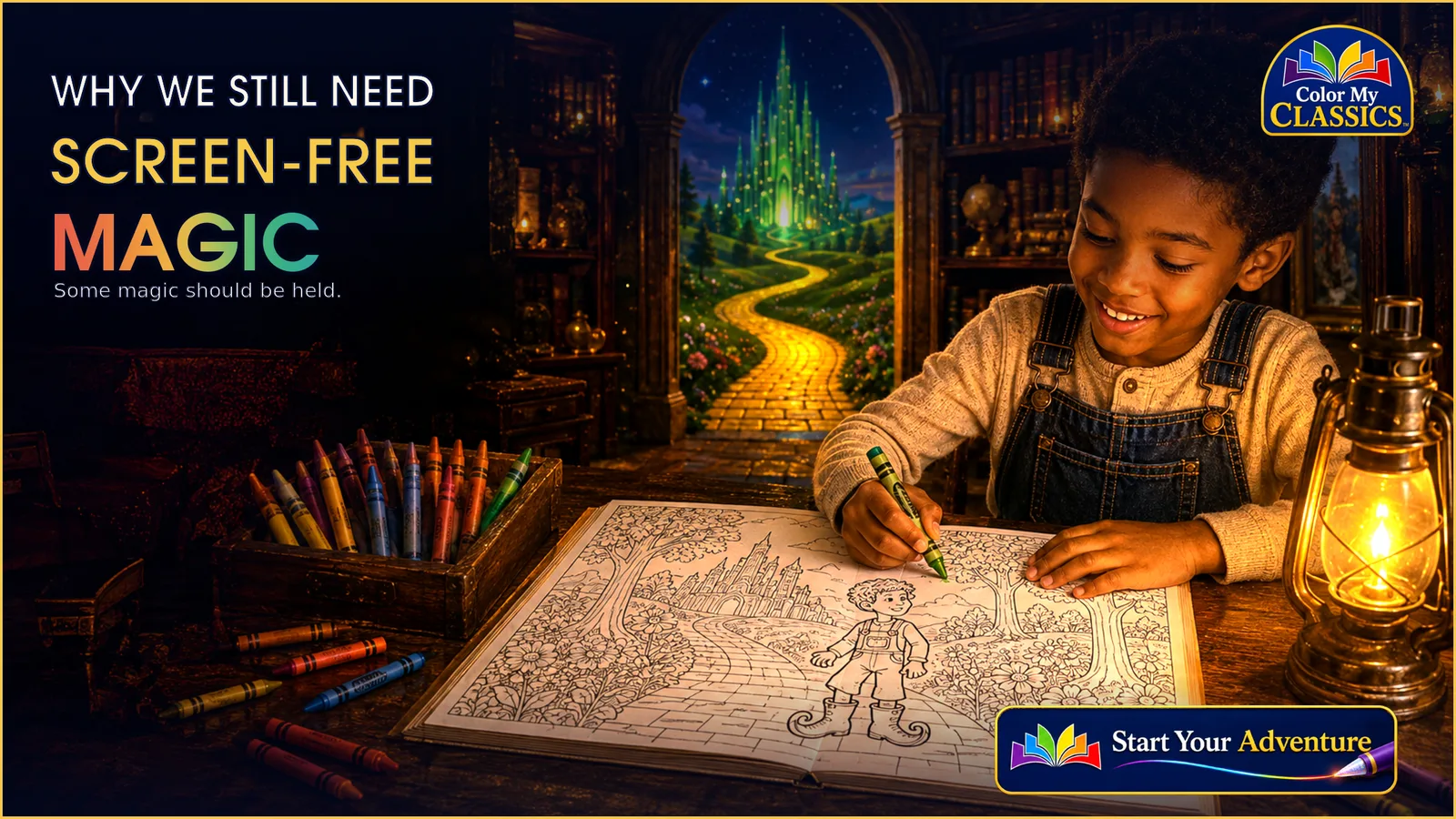
A paper page has no idea what comes next.
It does not autoplay. It does not send a notification. It does not hurry to show a child the next bright thing.
It waits.
That waiting is one of its quiet powers.
Children are growing up surrounded by screens that can teach, entertain, connect, and occasionally rescue a tired adult at exactly the right moment. Color My Classics uses technology too. We are not interested in pretending the future can be put back in a drawer.
We are interested in protecting a few places where the child—not the device—sets the pace.
Screen-free does not mean empty
When people search for screen-free activities for kids, the results often arrive as very long lists. Build this. Bake that. Go outside. Try 101 things before lunch.
Useful? Absolutely. Peaceful? Not always.
Screen-free time does not need to become another performance for a parent to manage. Sometimes it is simply a physical object that already contains a doorway: a book, a handful of crayons, and a child deciding where to begin.
There is no correct first move. They can read the words, study the picture, color one tiny star, skip three pages, or ask why a character made such a terrible plan. The moment has shape, but it is not scripted down to the second.
The page gives them somewhere to put their attention. Then it gives that attention something to do.
A physical story leaves room for the child
Many digital experiences arrive with the next move already designed. Tap here. Watch this. Collect the reward. Even beautiful, thoughtful apps still have to decide how the experience will move.
A coloring storybook can remain unfinished on purpose.
The sky has not chosen its color. The castle is waiting. The hero’s coat is only an outline. A child can press hard with a purple crayon, change direction halfway through, and decide that every tree in this particular forest grows orange leaves.
Nothing flashes when they make an unexpected choice. The page simply accepts it.
Personalization makes that openness feel even more immediate. When the uncolored character carries the child’s name and likeness, the question changes from “What should the hero look like?” to “What should I look like here?”
The child sees themselves—but not finished. That last part belongs to them.
A book is an easy thing to share
A physical book creates a small piece of common ground. Two people can see the same page. A grandparent can point without opening a menu. A child can lean against a shoulder, take the crayon back, and explain why the moon obviously needs to be green.
One small laboratory study offers a useful, limited signal. Researchers observed 37 parent-toddler pairs reading print books and tablet-based books for five minutes at a time. In that setting, the pairs showed less social reciprocity and more control behaviors around the tablets than around print.
That study does not prove that paper is always better, that tablets are harmful, or that every family will interact the same way. It does support something many adults recognize: a printed page can be a naturally uncomplicated object to gather around.
The real value is not the paper by itself. It is what people do beside it—pointing, wondering, disagreeing, inventing, and seeing the same thing together.
The goal is not perfect unplugging
Modern family life is already digital. The 2025 Common Sense Census found that children age 8 and under average about two and a half hours of screen media per day. Many use screens for entertainment, learning, communication, or simply getting through a busy afternoon.
Those numbers are context, not a score for parents.
The more useful question may be: What do we refuse to let screens crowd out completely?
The American Academy of Pediatrics suggests family media plans that fit real routines, with screen-free zones and room for reading, outdoor play, games, and hobbies. That is a gentler and more practical idea than waiting for the mythical week when everyone in the house suddenly becomes perfect at unplugging.
A family might protect bedtime stories. A rainy Sunday hour. Ten minutes at the kitchen table while dinner cooks. Screen-free magic does not require an entire lifestyle renovation. It only needs a place to happen.
Let technology do its work—and then disappear
This is where Color My Classics feels most itself.
Technology helps transform a child’s photo into a personalized line-art character and place their first name inside a classic adventure—the same idea explored in when a child steps inside the story. Then the technology steps out of the experience.
What remains is deliberately ordinary in the best way: a real book, black lines on white paper, and room for a child’s hand.
The smartest part of the process should not be the loudest part of the childhood memory. The child does not need to admire the machinery. They need to recognize themselves, reach for a color, and begin.
A physical book keeps the evidence
A screen can remember progress. A book remembers pressure.
It keeps the place where the crayon snapped, the page colored twice, the name written crookedly inside the cover, and the corner that softened because someone kept returning to the same scene.
Those marks are not damage to a coloring story. They are the second half of its authorship.
Years later, an adult can open the book and see more than a personalized character. They can see what the child chose when nobody supplied the color. They can see the age in the handwriting and the imagination in the impossible sky.
That is why screen-free magic still matters.
It is not what disappears when the screen goes quiet. It is what finally has room to appear: a question, a wrong turn, a green moon, a shared joke, and a child who sees their own outline and decides what happens next.
The page waits.
The child answers.