Every family has at least one story that belongs to a particular voice.
Maybe your grandmother read it slowly, as if the forest really did begin just beyond the edge of the page. Maybe your grandfather rushed through the dangerous parts and then stopped—always in the same place—to ask what you would do next.
Years later, you may not remember every line. But you remember the chair. The pause. The hand that held the book open.
That is the quiet power behind a meaningful Grandparents Day gift for grandchildren: it can carry more than a story. It can carry the way one generation once felt about that story—and leave room for the next generation to change it.
Stories are inherited in voices
We often talk about classic stories as if they survive because their plots are sturdy. That is only part of it.
Stories last because people keep bringing them back to life.
A grandparent adds a raised eyebrow at the foolish decision. A child interrupts with an urgent question. Someone remembers the edition that lived on a high shelf when they were small. The words may be familiar, but the telling is never exactly the same.
That shared attention matters. Scholastic’s family reading research found that 90% of surveyed parents see books as opportunities for conversation. A book gives two people a third thing to look at together—a place where questions can appear without either person having to force them.
And children do not necessarily outgrow the pleasure of being read with. Read-aloud frequency falls sharply after the early years, even though stories can keep opening doors between people long after a child can read independently.
Grandparents are beautifully placed to keep that door open. They often know how to let a story wander.
An old story should not become a museum piece
Passing down a classic does not mean asking a child to admire it from a respectful distance.
The child should be allowed to climb in.
They should be allowed to disagree with the hero, rename the horse, decide that midnight-blue trees make more sense than green ones, and wonder why nobody in the story simply asked for directions.
This is where a personalized coloring story becomes different from a beautifully finished book.
In a Color My Classics adventure, an adult uploads a clear photo, provides the child’s first name, and chooses a story adventure—how a child becomes part of the story. The child then appears inside the printed book as an uncolored black-and-white line-art character, with their name woven into the story.
They can recognize themselves—but the page has not made every decision for them.
Their face is there. Their name is there. Their colors are not.
That unfinished space is the invitation.
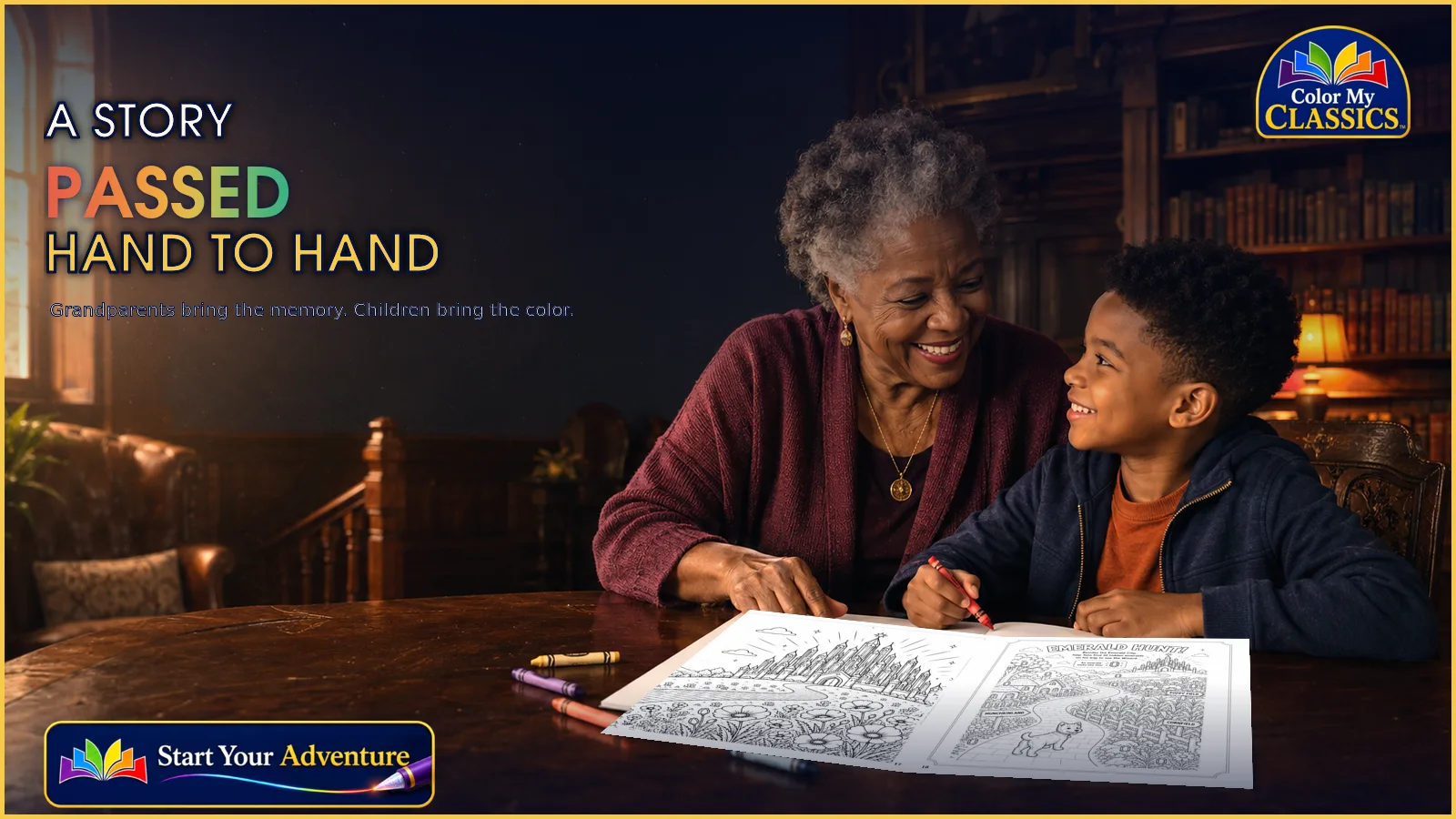
The grandparent brings the memory. The child brings the color.
A grandparent might bring a story they have loved for decades. They bring what frightened them, what made them laugh, and the strange detail they never forgot.
The child brings a completely different set of eyes.
They bring questions nobody predicted. They bring a purple crayon to the moon. They bring the absolute certainty that a friendly owl should appear in every chapter, whether the author planned one or not.
Together, they make a family version of the story.
That is not just a sweet idea. Recent research on family-memory transmission suggests that sharing personal memories is woven into how families experience closeness, especially between grandparents and grandchildren. A familiar story can make those memories easier to tell: “I loved this part when I was your age.” “This character reminds me of…” “We had a book like this in our house.”
The classic adventure becomes a bridge. The family stories are what cross it.
Try the Storykeeper’s Reading Ritual
No lesson plan is required. No grand performance either.
Choose one page, sit close enough to share it, and ask three questions:
- What did you notice in this story when you were little? The grandparent answers first.
- Which character would you follow—and why? Let both answers be different.
- What color belongs on this page today? The child gets the final word.
Those questions work in the same room, but they can also work across distance. During a video or phone call, the child can hold up a page, the grandparent can tell one memory, and the child can choose the color that carries the story forward.
Five unhurried minutes is enough.
A meaningful gift is sometimes time with a handle
Gift guides often divide presents into “things” and “experiences.” A book can be both.
It is a thing a child can unwrap, carry, return to, and place on a shelf. But it is also a ready-made reason to sit together—the same idea explored in why a physical page creates a different rhythm. It gives hands a job and conversation somewhere to begin.
That is especially useful for grandparents who want connection but do not want to arrive with a complicated activity to manage. Open the cover. Find the child in the story. Choose a color. Tell one memory.
The book does not need to do more than that.
And if the coloring wanders outside the lines? Good.
If the grandparent chooses a color the child rejects? Even better.
The disagreements, stray marks, and half-finished pages are not flaws in the keepsake. They are evidence that two people were there.
Let the story come back changed
A classic story can survive for generations without staying frozen.
First, a grandparent remembers the version that found them.
Then a child finds their own face inside the adventure, reaches for a crayon, and makes a choice nobody made before.
The story passes hand to hand.
When it returns to the shelf, it carries both of them.
Some stories stay with us forever. Now a child can help decide what the next version looks like.