I do not remember every sentence.
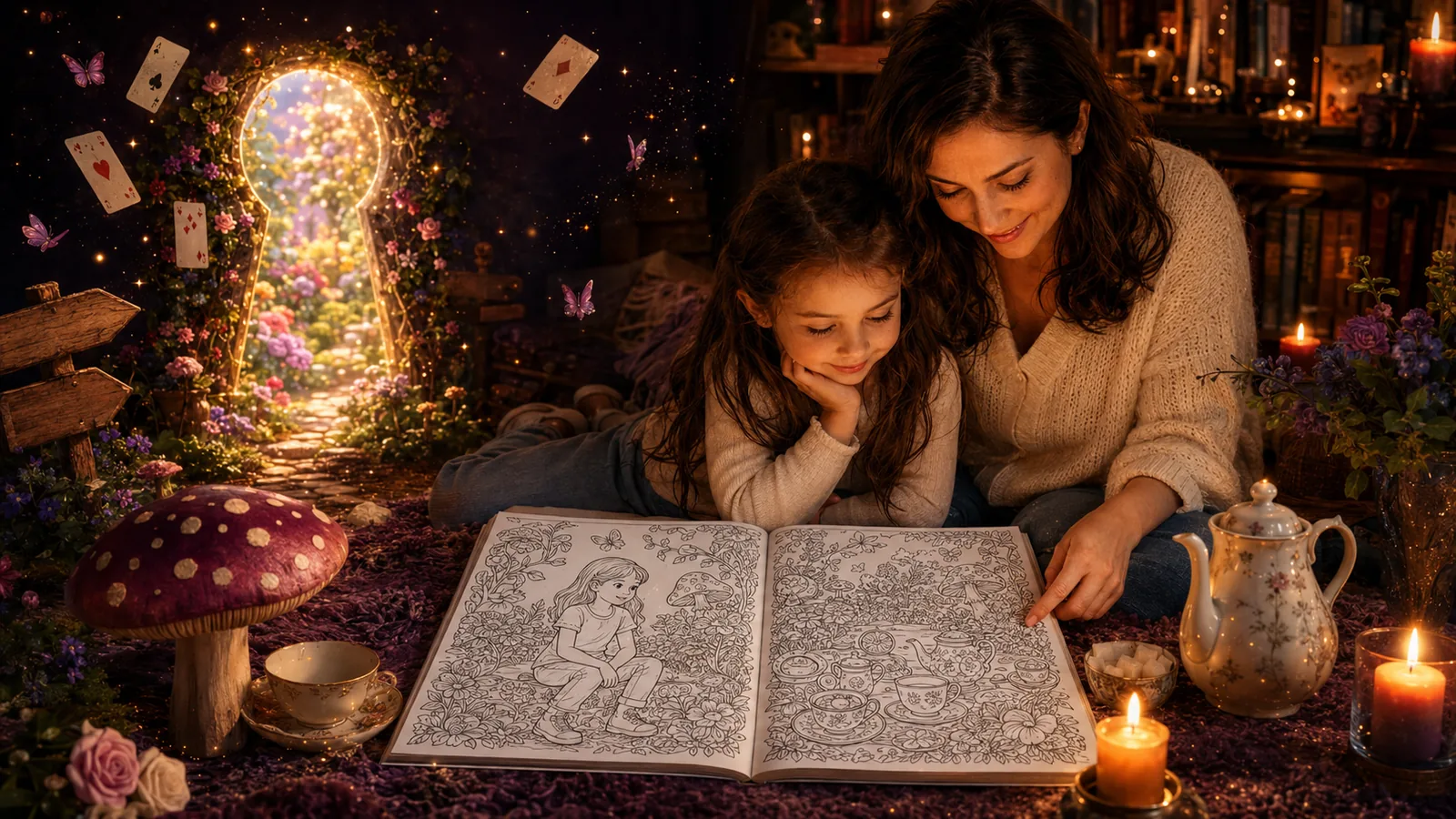
I remember the keyhole.
I remember the road stretching toward a city that looked impossible. I remember an open nursery window and the uneasy idea that growing up might mean leaving something behind.
That is how many childhood stories stay with us. The plot softens at the edges. The feeling does not.
Years later, a teacup, a pair of magic shoes, or the thought of flying over rooftops can open a door we did not know was still there. For a moment, the room changes. We are back inside the story—and back beside whoever first helped us enter it.
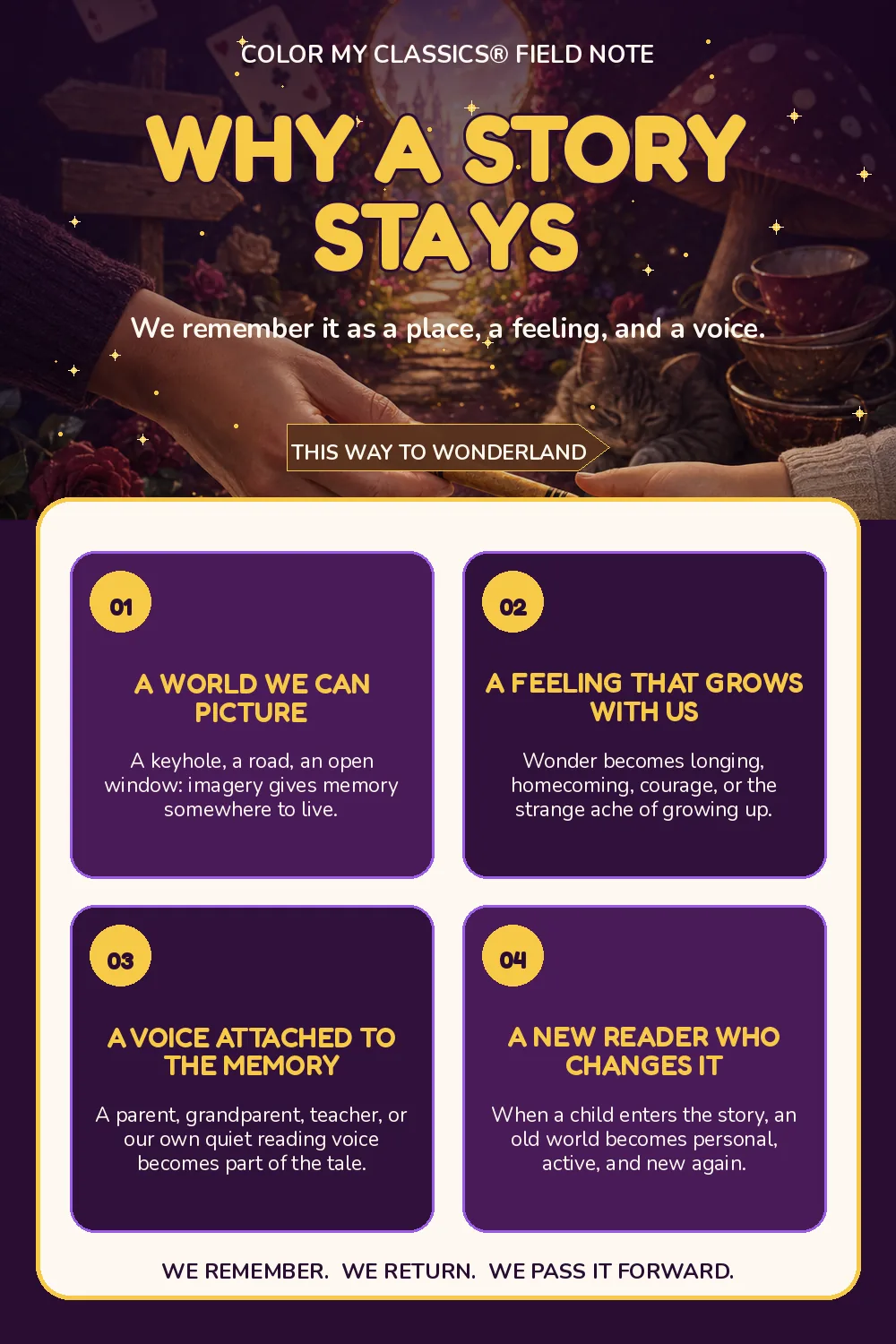
We remember the world before we remember the words
Some books become less like books and more like places we have visited.
Researchers use the phrase narrative transportation for the experience of becoming absorbed in a story through attention, emotion, and mental imagery. The name feels almost too neat for something so strange. A reader sits still, turns paper pages, and somehow travels.
That may be why a few images remain long after the wording is gone.
Wonderland gives us a door that is too small, a tea party that obeys no sensible rules, and the delicious suspicion that the grown-ups may not know what they are doing.
Oz gives us a road, unlikely companions, and a question about what we already carry inside ourselves.
Peter Pan gives us flight, an open window, and the ache hiding inside the wish not to grow up.
The worlds are vivid enough for a child to enter and roomy enough for an adult to return with different questions.
The story changes because we do
As children, we may follow the adventure.
As adults, we notice the leaving.
We notice the homes people are trying to reach, the rules they are learning to question, the friends who believe they are missing something essential, and the parents waiting near the edge of the page.
The book has not changed. We have.
That is one reason rereading a childhood classic can feel both comforting and a little unsettling. We are meeting the story we remember, but we are no longer the person who first read it.
Sometimes we discover that our memory improved the book. Sometimes we find a strange passage we had completely forgotten. Sometimes the scene we loved still works exactly as it did, and that feels like finding a lamp glowing in a house we thought had been empty for years.
A beloved story is rarely ours alone
When adults talk about childhood books, another person often appears in the memory.
The teacher who gave every character a different voice. The grandfather who skipped a paragraph because dinner was ready. The parent who kept reading the same chapter because one small listener was not prepared to let the evening end.
The story becomes attached to a ritual: the chair, the blanket, the rainy afternoon, the hand holding one side of the book flat.
Research on nostalgia and family tradition helps explain the impulse that follows. In a six-study paper, nostalgia was linked with parents wanting to pass traditions to their children, with relationship closeness playing a role. That does not mean sharing one book manufactures a bond. It means the wish to hand something beloved forward is real, recognizable, and deeply human.
We do not only want children to know the stories.
We want to see what the stories become with them.
Why a story stays
Then the next reader steps inside
There is a difference between showing a child the doorway and letting them walk through it.
In a Color My Classics adventure, an adult uploads a clear photo, adds the child’s first name, and chooses one of the currently available story worlds: Oz or Wonderland. The child’s likeness becomes an uncolored black-and-white line-art hero woven into a physical coloring storybook.
The child is recognizable, but unfinished.
Their face is part of the story. Their name is part of the story. The colors are still waiting for them.
That waiting matters.
A finished illustration says, “Here is the world.”
A coloring page asks, “What will you do with it?”
The child can make the mushroom gold, the sky green, or the road a color nobody has named yet. They are not simply inheriting an adult’s memory of a classic. They are making a version that could not have existed without them.
Peter Pan belongs in this conversation because its questions about childhood and growing up still follow readers into adulthood. It is not currently a Color My Classics product. CMC’s live adventures are inspired by the original public-domain books of Oz and Wonderland—not movie versions.
The new heirloom begins unfinished
We usually imagine an heirloom as something old, careful, and complete.
But some heirlooms begin as ordinary things a child loves enough to change.
A name written crookedly on the inside cover. A purple crayon pressed too hard. One page colored beautifully and the next abandoned halfway through because something more urgent happened in the kitchen.
Those marks may look small now. Twenty years later, they may be the whole reason the book matters.
The adult brings the story they remember.
The child brings a new hero, new questions, and the colors.
The classic survives—not by staying untouched, but by making room.
Some stories stay with us forever.
The luckiest ones do not stay exactly the same.
If there is a story you are ready to pass forward, create their Color My Classics adventure in Oz or Wonderland.